
Definition
What is an AI receptionist?
An AI receptionist is a software system that answers inbound phone calls with a voice AI agent, understands intent in natural language, and completes routine tasks—book, reschedule, cancel, check availability—by calling backend APIs. In this case study, the AI receptionist runs on Retell → n8n → Express API → PostgreSQL, so voice and web bookings share one calendar. For a plain-English overview of benefits, costs, and use cases, see what an AI receptionist is.
Story
This AI receptionist case study documents a production voice AI appointment booking stack: callers book by phone while web visitors use the same Postgres calendar.
Missed calls and slow response were costing qualified leads—especially when prospects compared you to competitors who answered the first time. The team needed instant answers, structured bookings, and one calendar the ops layer could trust.
Problem
Fragmented intake
Leads arrived through forms, calls, and DMs, but confirmed bookings lived in different places—voicemail, chat, spreadsheets. After-hours callers dropped. Reporting disagreed on what was booked.
Solution
One Postgres pipeline
Voice routes through Retell → n8n → Express API → Postgres. Web booking uses the same database when DATABASE_URL is aligned. See also n8n workflow automation.
What shipped, how each request moves through the stack, and the tools involved—before we go deeper on comparison, architecture, and FAQ.
What the system does
Capabilities once voice, automation, and API layers are wired together.
- AI voice agent (Retell) with custom functions into n8n
- Natural-language → structured actions (book, availability, cancel, reschedule)
- Dedicated Express API + Postgres as system of record
- Same booking rows for web + voice when DATABASE_URL is aligned
- Payload validation before writes; date normalization in IST / relative phrasing
- Observable orchestration—fix workflows without redeploying voice prompts
Outcomes
What this unlocks
Unified funnel
Voice + web land in one pipeline instead of split inboxes.
Faster lock-in
Structured handoff beats voicemail ping-pong for hot leads.
Efficient triage
Automate first-line scheduling without full-time reception load.
Consistent policy
Same validation path every time—fewer edge-case rows.
How it works
End-to-end booking flow
Real-time path from caller to database—the same steps power the HowTo structured data on this page.
- Step 1
Caller speaks intent
A caller dials in (or opens a browser voice session) and describes the booking they want in plain language.
- Step 2
Retell voice agent captures and structures the request
The Retell voice AI agent handles dialogue and uses a custom function to POST the structured request to an n8n webhook.
- Step 3
n8n orchestration validates and normalizes
n8n validates fields, normalizes dates (including relative phrases like 'tomorrow at 3pm'), branches on intent, and calls the booking API with clean JSON.
- Step 4
Express booking API enforces rules
The Express API verifies availability, applies booking rules, and writes the row to PostgreSQL—the same table the public website uses.
- Step 5
PostgreSQL becomes the system of record
PostgreSQL stores the booking with constraints, so dashboards, email confirmations, and reporting see one consistent calendar.
- Step 6
Confirmation returns to the caller
A structured response flows back through n8n to the voice agent, which confirms the slot to the caller in natural language.
Tech stack
Tools in play
Retell AI
Handles real-time voice conversations and maps caller intent to structured tool calls—not ad-hoc scripts.
n8n
Routes and automates requests: branching, retries, date normalization, and HTTP to your API with visibility when something breaks.
Node.js / Express
Enforces booking rules at the boundary: schema validation, availability checks, and safe writes before anything hits the database.
PostgreSQL
Stores bookings and availability as the single source of truth so dashboards, email, and web stay aligned.
Ubuntu VPS
Typical production home for the API and automation tier—portable to your preferred host or region.
We needed one calendar truth—voice couldn't be a side channel anymore. Web and phone had to write the same rows, or ops would never trust the dashboard.
Results
- 24/7 first-line call handling without tying up human staff for routine scheduling questions.
- Instant response on the voice path versus voicemail queues that stretch to minutes or hours.
- Fewer missed leads when after-hours and peak-time callers can complete or reserve structured intent.
- A fully automated booking path from conversation → validation → confirmation → the same rows your web channel uses.
Comparison
AI receptionist vs voicemail, IVR & human reception
Four ways teams handle inbound calls—compared on availability, how intent is captured, whether a booking actually lands in your calendar, and who each approach suits.
Voicemail / missed call
- Availability
- Whenever the line is unattended
- Intent capture
- Unstructured audio; manual review required
- Booking mechanism
- Human call-back during business hours
- Data consistency
- Lives outside the calendar until logged manually
- Best for
- Very low call volume with abundant staff time
Traditional IVR (press 1, press 2)
- Availability
- 24/7
- Intent capture
- Fixed menu options only
- Booking mechanism
- Routes to humans or web form; rarely books on the call
- Data consistency
- Depends on the downstream system reached
- Best for
- Simple routing where intent fits 3–4 menu options
Human receptionist
- Availability
- Office hours only
- Intent capture
- Natural language; high quality
- Booking mechanism
- Manual entry into calendar / CRM
- Data consistency
- Strong when one tool is used; drifts across spreadsheets
- Best for
- Low-volume, high-touch bookings or compliance-sensitive intake
AI receptionist (this case study)
This case study
- Availability
- 24/7, including after hours and overflow
- Intent capture
- Natural language via voice AI (Retell)
- Booking mechanism
- n8n → Express API → PostgreSQL; structured write on the call
- Data consistency
- Single source of truth shared with the web booking flow
- Best for
- Repetitive appointment booking with steady or spiky call volume
Fit
When this pattern fits (and when it doesn't)
Strong fit
- You book appointments by phone today and miss calls after hours, during peak times, or on weekends.
- You already have a web booking flow but voice and web data live in separate places, hurting reporting.
- Your bookings are repetitive enough to fit a small set of intents: book, reschedule, cancel, check availability.
- You can give the system a calendar, a database, and clear validation rules (required fields, duration, business hours).
- Compliance allows automated voice handling for first-line intake (sensitive industries may need scripted disclosures).
Probably not a fit yet
- Complex, regulated intake (e.g. clinical triage) where every call needs a licensed human in the loop.
- Very low call volume where a human can handle every call within minutes—automation may not pay off.
- Calendars and CRMs with no API or no programmable booking endpoint (the API tier needs somewhere to write).
- Use cases that demand emotional discovery on every call (sales discovery, crisis response) more than routine scheduling.
Architecture
How the AI Receptionist Works (Architecture & Flow)
Production-grade voice booking: callers and web visitors meet the same rules engine; automated appointment scheduling runs against live availability.
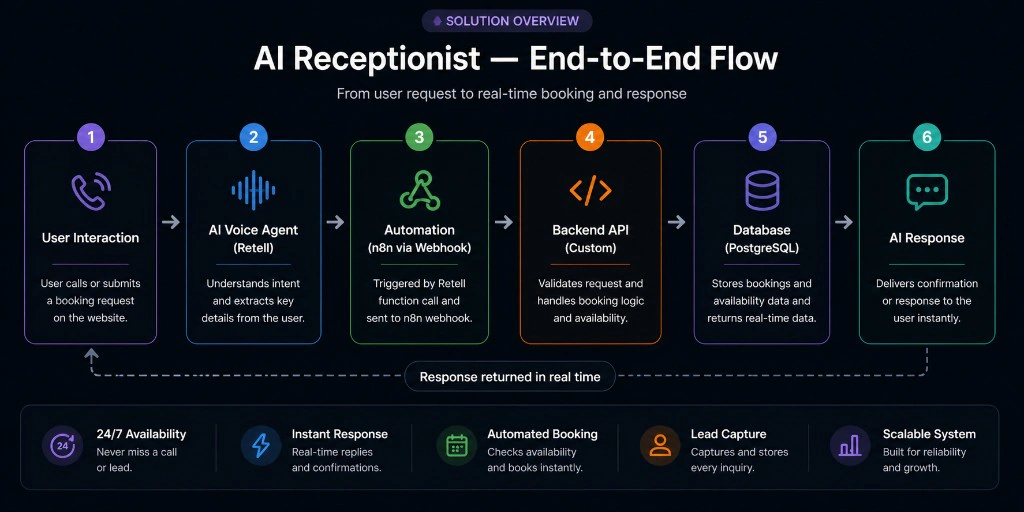
The diagram above is the voice-led path (Retell → n8n → Express booking API → Postgres). Web self-serve booking on this site uses Next.js server routes into the same database and does not traverse n8n; optional browser voice (when enabled) follows the Retell path. Keep DATABASE_URL aligned across hosts so both channels stay one calendar.
AI receptionist workflow: voice AI (Retell) captures intent, n8n automates via webhook, the backend API validates and applies booking logic, and PostgreSQL stores the availability so users get real-time confirmation.
Experience layer
- Public Next.js site with an indexable appointment flow and optional browser voice entry points where enabled.
- Retell AI voice agent with custom functions mapped to orchestrated endpoints—not fragile one-off scripts.
Orchestration
- n8n workflow as the control plane: normalize dates (including locale-aware “today / tomorrow”), branch on validation, and call the API layer with predictable payloads.
- Operational visibility: failures surface in the automation layer so you can fix workflows without redeploying the entire voice stack.
Systems layer
- Dedicated API service backing availability checks and confirmed bookings into Postgres.
- One database truth for bookings so dashboards and reporting reflect web and voice the same way.
Try the public scheduling surface on the appointment page.
Production
Reliability choices that matter
- Payload validation — incomplete records are rejected before write.
- Date normalization — relative language resolves to calendar-safe dates before availability checks.
- Environment alignment — one database backs site and API so dashboards stay consistent.
Glossary
AI receptionist glossary
- AI receptionist
- An AI receptionist is an automated voice agent that answers inbound phone calls, understands caller intent in natural language, and completes routine tasks such as booking, rescheduling, or canceling appointments by calling backend APIs.
- Voice AI appointment booking
- Voice AI appointment booking is the use of a real-time voice agent (e.g. Retell) to collect a caller's intent and book a structured appointment against a live calendar, instead of taking a message or routing to a human.
- Workflow orchestration (n8n)
- Workflow orchestration is the layer that sits between an AI agent and your APIs. In this case study, n8n receives webhooks from Retell, validates and normalizes payloads, applies branching logic, and calls the booking API with predictable JSON.
- Booking API
- The booking API is a dedicated Express service that exposes endpoints for availability, booking, cancellation, and rescheduling. It validates inputs and writes to PostgreSQL—the system of record for both voice and web bookings.
- Single source of truth
- A single source of truth means web and voice bookings write to the same PostgreSQL database, so dashboards, reports, and email confirmations always agree on the calendar.
Want a similar AI system for your business?
Map your stack, risks, and rollout in a short working session—no obligation beyond clarity.
Frequently asked questions
How the receptionist behaves, what each layer does for your business, and what to expect before you reach out.